Sustainable development is essential to prevent the most severe impacts of climate change, which translates into the urgency to drastically reduce greenhouse gas emissions across all sectors. With a full commitment to achieving climate neutral goals, EURADA believes that climate action is also a precondition for regional competitiveness.
On the 14th of April, EURADA was invited to participate in the TREASoURcE Final Conference –Circular systemic solutions: From demos to deployment. The Conference demonstrated, among others, the high potential of stakeholder engagement, scalability of pilots and replicability of solutions for accelerating the circular transition.
The Conference showcased the main achievements and takeaways of the TREASoURcE project (which is part of the European Union’s Circular Cities and Regions Initiative (CCRI)), including demonstrations of systemic circular economy solutions in cities and regions on plastics, batteries and biobased side and waste streams.
The event was opened by keynote speaker Lucie Blondel (European Commission), who highlighted that circular economy is at the heart of the competitiveness agenda and plays a key role not only in the green transition but also in the industrial and market robustness. She emphasised that the CCRI contributes to responding to the implementation gap of pilots through real deployment and scaling of circular solutions in cities and regions.
During a panel exploring enabling conditions for circular economy, Camille Herlaut, Junior Policy and Project Officer in EURADA, presented EURADA’s contribution to achieving the green and circular transition through its participation in several European projects, specifically the CCRI Knowledge Hub, CircSyst, Just Fashion and FRONTSH1P (finished in November 2025).
In addition, Dr. Athanasia-Maria Tompolidi, Policy and Project Officer in EURADA, contributed to the Roundtable of that same panel. She emphasised that scaling circular economy solutions requires a coordinated mix of governance, collaboration, and market creation across regions. She also highlighted replication, peer learning, and the removal of regulatory barriers as key to successful cross-regional circular systemic solutions.
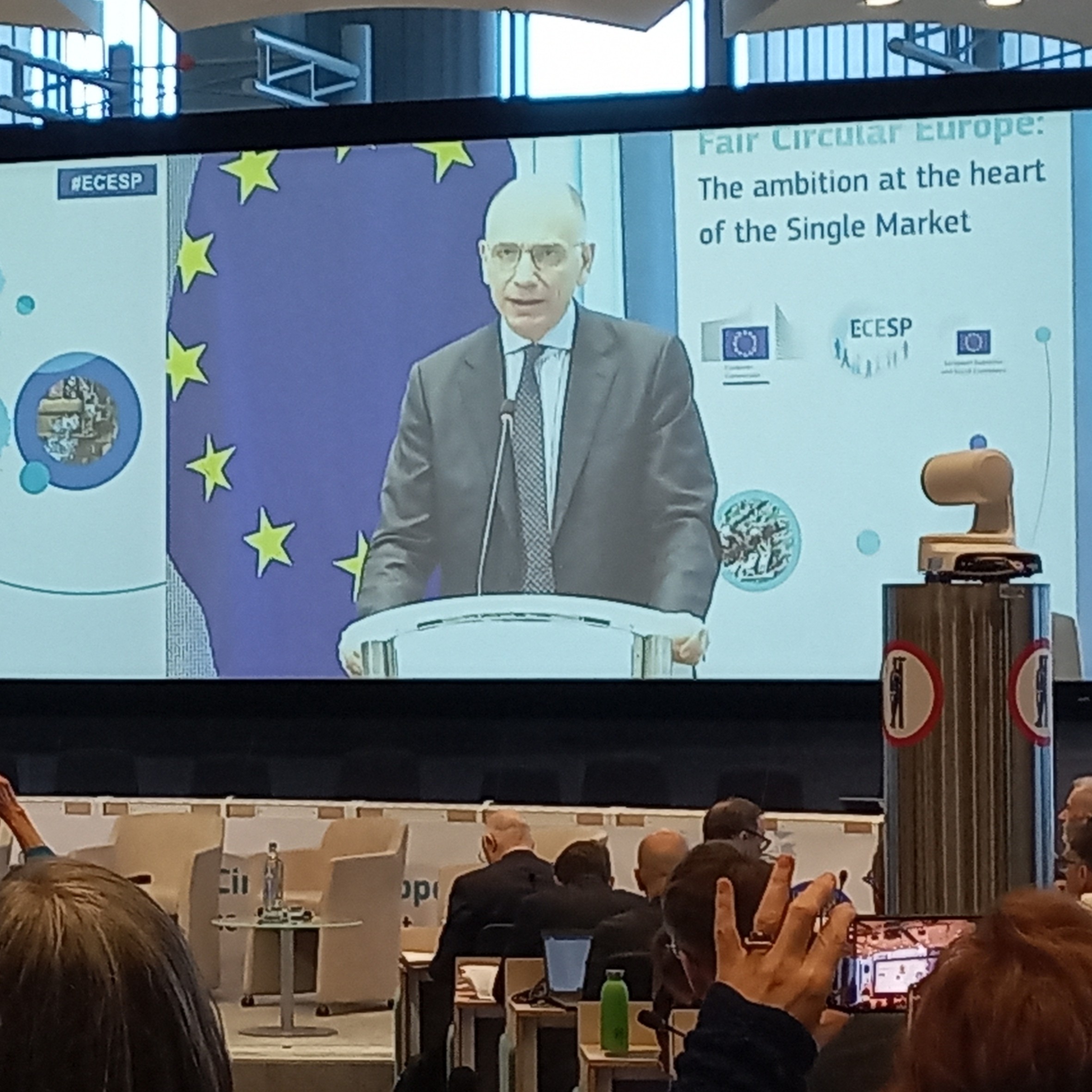
The month of April was also marked by the ECESP Annual Conference, held on the 22nd and 23rd. Under the theme A competitive and fair circular Europe: The ambition at the heart of the single market, the Conference emphasised the urgency to consider circularity not only as an environmental ambition, but also as a core strategy of the EU competitiveness agenda, reinforcing resilience and self-sufficiency. To achieve these objectives, an effective framework is essential, and the Circular Economy Act plays a central role in this regard. The discussions explored the implications of the upcoming Circular Economy Act, which will allow to move from fragmented approaches to a unified and harmonised framework. Moreover, the Act will be key for boosting demand for secondary raw materials, building trust among stakeholders and ultimately making circularity a mainstream practice. Another distinctive aspect of the discussions focused on stakeholder engagement and structured cooperation between policy and businesses. The discussions emphasised the need to transform circular ambition into on-the-ground action, reduce boundaries to the businesses and ensure reliability of circular solutions.
The Conference started with the keynotes from Ms Jessika Roswall (Commissioner for Environment, Water Resilience and a Competitive Circular Economy) and Mr Séamus Boland (President of the European Economic and Social Committee). Roswall reflected on the role of circular economy in reducing Europe’s vulnerability and dependency and ensuring its strength and resilience. She highlighted the Circular Economy Act as an essential framework to build a stable and integrated market supporting circular solutions. Boland put emphasis on grounding policies on the principles of circular economy and defined circularity as a choice for sustainability, competitiveness and fairness and as a driver for self-sufficiency and ownership. Both Roswall and Boland agreed on the need for partnerships across sectors and stakeholders.
Further, Mr Enrico Letta (Dean IE University and President Jacques Delors Institute) expressed the European institutions’ ambition to move beyond the Single Market toward “One Europe, One Market” to strengthen Europe’s competitiveness. The author of the Report on the Future of the Single Market pointed out the importance of recognising the Circular Economy Act as one of the pillars of the “One Europe, One Market” agenda, and identified circularity as an essential aspect of the EU’s strategic autonomy.
These two events have demonstrated that regions are an ideal setting for translating circular ambitions into tangible actions. Acting as “living labs”, they are at the forefront of the development of circular projects. To ensure that circularity becomes a mainstream practice, structured collaboration among regions is essential, creating opportunities for scalability of projects, replication of practices and strengthening interregional networks. In this context, connecting regional initiatives to policymaking processes is crucial to co-create a comprehensive framework. Ultimately, circular economy can play a pivotal role in reinforcing territorial competitiveness. EURADA is actively involved in the achievement of the circular transition as a partner to several European projects covering different topics on circular economy and sustainability, and through its work to promote circularity among regions.