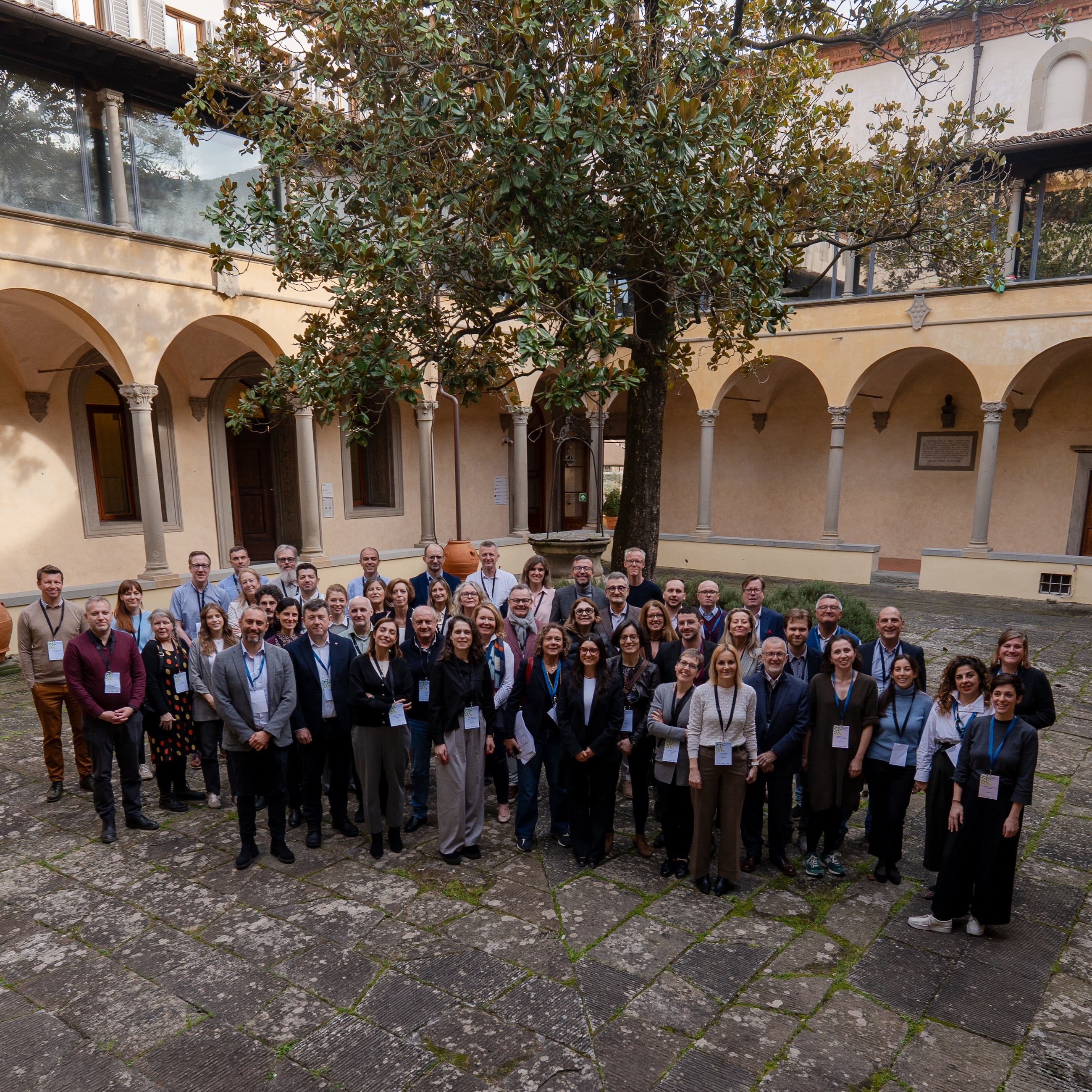
On 2–3 March 2026, policymakers and practitioners from across Europe gathered in Florence, at the European University Institute (EUI), for the second in-person Capacity Building event of the EU Preparatory Action “Innovation for Place-Based Transformation.”
The workshop marked an important milestone in the initiative’s Capacity Building programme, bringing together around 50 representatives from more than 30 European territories to move from conceptual discussions on place-based innovation to hands-on policy experimentation. Following the first in-person meeting held in Sofia in November 2025, which focused on engagement, envisioning and orchestration of transformative change, the Florence event shifted the focus towards designing, implementing and testing policy approaches that can help territories tackle complex societal challenges. Hosted by the European University Institute, a leading academic institution dedicated to research and policy dialogue on European integration, the event offered an inspiring setting for collaboration between regional policymakers, EU institutions, researchers and innovation practitioners.
Learning by doing: a policy simulation for transformative missions
At the heart of the Florence workshop was an interactive policy simulation exercise, where participants worked in mixed groups acting as a European Task Force, tasked with designing a transformative mission for a fictional basin-region. Through this simulation, participants applied the tools and concepts introduced throughout the Capacity Building programme and the JRC ACTIONbook for Innovation for Place-Based Transformations.
The exercise followed a structured step-by-step methodology, allowing participants to experience the challenges of designing and implementing place-based innovation policies. Teams were first asked to identify a systemic territorial challenge affecting the fictional region and translate it into a concrete mission. They then mapped key stakeholders and power dynamics, identifying potential champions, blockers and the conditions under which different actors might support the initiative. Building on this context analysis, participants worked to define a shared mission statement, including signals of success that would demonstrate its long-term impact on the territory. From there, teams explored governance structures, coalition building and collaboration models, identifying which institutions could lead the mission and which partners would need to be involved. Finally, each group designed a strategic pilot or experiment to test their approach, outlining the intervention, target actors, expected impact pathway and the uncertainties that the experiment would aim to address.
A distinctive element of the exercise was the use of an AI-enabled chatbot, which helped bring the fictional region to life. Participants could interact with the chatbot to gather contextual insights about the territory and engage with simulated stakeholders representing different interests within the regional ecosystem. By posing questions to these virtual actors, teams were able to explore concerns, trade-offs and incentives that might influence the implementation of their proposed mission. This tool added an additional layer of realism to the simulation, helping participants better understand the complexity of stakeholder engagement, negotiation and decision-making in transformative innovation policies.
Over the two days, the simulation moved from diagnosing territorial challenges todesigning mission proposals and policy experiments. Participants explored how governance arrangements, policy instruments and collaboration across regional ecosystems could support implementation. Rather than developing full strategies, teams focused on testable interventions that could generate insights and inform future policymaking. The exercise concluded with a gallery-style showcase, where groups presented their proposals and exchanged feedback on different approaches.
The workshop also featured reflections from leading voices in innovation policy and research. Vladimír Šucha, Fellow at the European University Institute and former Director-General of the Joint Research Centre, discussed the importance of place-based innovation in the age of artificial intelligence, emphasising the need for human-centred approaches to technological transformation.
Laurène Le Cozanet, Professor at the European University Institute, reflected on the role of universities in supporting territorial transitions and fostering collaboration between research, policy and regional ecosystems.
The event was opened by Emanuela Bellan (Joint Research Centre), Heike Raab (European Committee of the Regions), Silvia Burzagli (Regione Toscana), and Armando Barucco (European University Institute), with additional contributions from members of the European Committee of the Regions.
The Florence workshop forms part of the EU Preparatory Action “Innovation for Place-Based Transformation,” implemented by the Joint Research Centre (JRC) together with Climate-KIC, ERRIN and EURADA. The initiative supports territories in strengthening their capacity to design, implement and learn from transformative innovation policies through a mix of online modules, peer exchange, experimentation activities and in-person workshops.
For regional development and innovation agencies, the initiative also highlights their role as key connectors within regional innovation ecosystems, helping translate policy ambitions into concrete projects, partnerships and experimentation activities that strengthen territorial competitiveness and resilience. Several EURADA member agencies are actively involved in the Capacity Building Programme, contributing to peer learning and exchange with other European territories working on place-based innovation approaches.