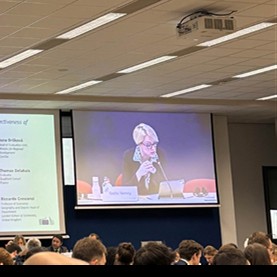
The 10th Conference on the Evaluation of the EU Cohesion Policy provided an important opportunity to reflect on the achievements of one of the European Union’s main investment instruments and to consider the adjustments needed to secure its continued relevance in a changing geopolitical and economic landscape. As global competition intensifies and regional disparities persist, the conference focused not only on past performance but also on how Cohesion Policy can remain effective, strategic and forward-looking.
The overarching message was clear: Cohesion Policy delivers tangible results. Across the European Union, it has strengthened transport infrastructure, supported research and innovation, enhanced administrative capacity and promoted social inclusion. Poland’s experience, highlighted during the conference, demonstrated how the policy can drive structural transformation by improving connectivity, boosting investment attractiveness and reinforcing resilience. Cohesion Policy continues to act as a collective European investor, generating benefits across the EU that extend beyond national borders.
At the same time, participants stressed that impact depends not only on funding volumes, but also on institutional quality and long-term strategic direction. Domestic reforms, governance systems and administrative capacity remain decisive in shaping outcomes. The growing complexity of infrastructure projects, programme transitions and crisis responses has made adaptability and change management essential competences for public authorities. Effective implementation requires strong institutions capable of aligning resources with clearly defined development priorities.
Capacity building emerged as a central theme. Stronger coherence between EU funds and regional governance systems is needed, alongside a better understanding of how administrative capacity evolves over time. Without robust data systems and analytical expertise, evidence-based policymaking remains difficult. The acceleration of digital and green transitions further increases pressure on regional administrations, requiring new technical skills, improved coordination mechanisms and integrated approaches across sectors.
Evaluation was discussed not merely as a compliance exercise, but as a strategic tool. In some cases, the absence of long-term regional development strategies makes it difficult to define meaningful indicators or measure territorial impact beyond individual projects. Data limitations and resource constraints in evaluation systems persist across many countries, and beneficiaries often perceive evaluation procedures as complex and burdensome.
A strong message from the conference was that evaluation frequently comes “too little, too late.” Rather than focusing primarily on ex-post assessment, evaluation should be embedded throughout implementation as a continuous learning mechanism. When integrated into delivery systems, it enables real-time adjustments, strengthens institutional capacity and increases overall impact. Examples presented during the conference from environmental projects achieving substantial emissions reductions to integrated healthcare reforms lowering mortality rates illustrated how systematic learning can amplify results. Cross-border initiatives further demonstrated the importance of transnational knowledge exchange in improving policy design and implementation.
Another key insight was the need to create genuine users of evaluation. Reports alone do not drive change. Continuous dialogue, stakeholder engagement and trust-building are essential to ensure that findings inform policy decisions and programme adjustments. Evaluation should therefore support cooperation and innovation, rather than remain an isolated technical requirement.
The broader context adds urgency to these reflections. Geopolitical tensions, value chain restructuring and rapid technological change are reshaping Europe’s economic environment. While the digital transition offers significant opportunities, it can also deepen regional disparities. At the same time, green and digital investments require financial mobilisation beyond the public sector alone.
In this context, Cohesion Policy must continue to balance cohesion and competitiveness. Its future effectiveness will depend on strategic clarity, strengthened administrative capacity, embedded learning systems and flexibility to adapt to change. The conference reaffirmed that Cohesion Policy remains a cornerstone of European integration. Ensuring transformative impact across regions will require not only sustained funding, but smarter implementation and stronger alignment between strategy, capacity and evaluation.