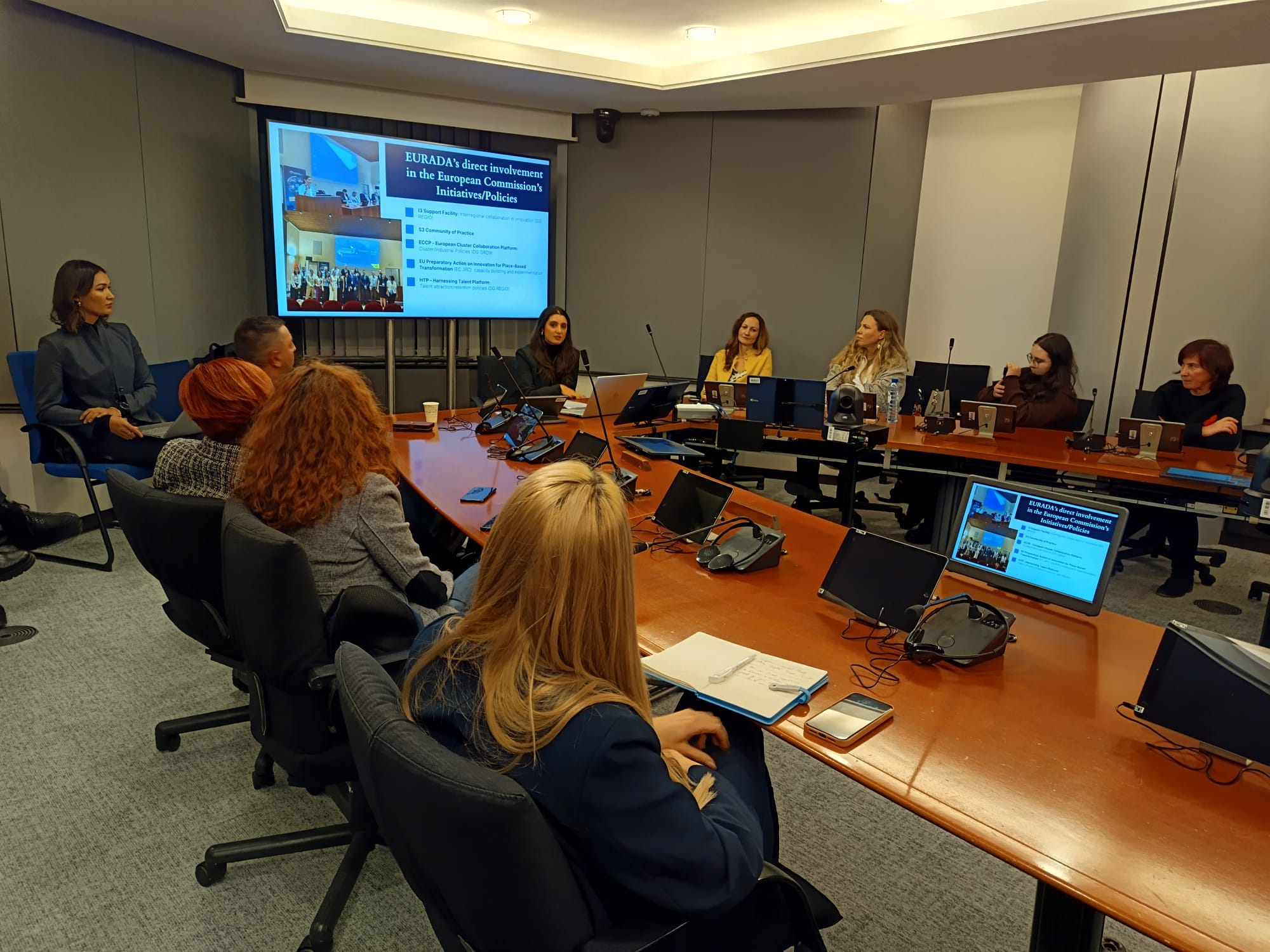
The visit took place within the “Partnership for Employment 2.0” project funded by the European Social Fund+, coordinated by the Civitas Foundation for Civil Society, and designed to improve labour market services, professional retraining and social inclusion across Romania.
The one-hour session, delivered by Giacomo Frisanco, Alessandra Frassetto and Jade Connoly introduced the delegation to what EURADA is, how it works, and how NGOs can connect with Europe’s regional development ecosystem.
The presentation began with an overview of EURADA’s mission and how it brings together more than 50 RDAs from 14 EU and EFTA countries, including four in Romania:
- ADR Centru – Center Regional Development Agency
- ADR Nord-Est – North-East Development Agency
- ADR Nord-Vest – North-West Regional Development Agency
- ADR Sud-Vest Oltenia
Participants gained insight into how RDAs function as regional development engines: coordinating strategies, mobilising funds, supporting businesses and social economy actors, and designing programmes addressing skills, innovation and territorial development.
The Role of NGOs in Regional Development
Because the visiting organisations work on training, employment, social economy and social inclusion, a key part of the exchange explored how NGOs fit into regional development strategies.
EURADA emphasised that NGOs are critical partners for RDAs because they:
- work closest to vulnerable communities
- detect skills needs and emerging labour-market gaps early
- pilot innovative approaches to retraining and social inclusion
- strengthen community participation and outreach
When NGOs collaborate with RDAs, their projects can be integrated into broader territorial strategies, increasing impact, sustainability and visibility.
The presentation also briefly referred to the Technical Assistance carried out under the European Commission’s Harnessing Talent Platform (HTP) on which EURADA form part of its consortium. This reference was included because Romania is directly involved in the initiative: (although EURADA was not part of the team supporting Romania), the Vest Region was selected as a beneficiary of the Technical Assistance. In addition, several of EURADA’s Romanian members are working intensively on demographic and labour-market challenges closely linked to the Talent Booster Mechanism. Their experience offered useful examples for the visiting NGOs and illustrated concrete avenues for future collaboration.
In this context, the Talent Booster Mechanism was presented as a practical case study demonstrating how regions are addressing skills shortages, brain drain and demographic pressures, and how NGOs can play a meaningful role in similar initiatives within their own territories.
The Civitas Foundation expressed appreciation for the clarity and usefulness of the session, noting that the information shared by EURADA was “extremely useful” for their participants and that they look forward to maintaining cooperation.
For EURADA, the meeting reaffirmed the importance of bridging EU-level regional development work with grassroots organisations that work directly with people and communities.
As Europe confronts skills shortages, demographic decline and major labour-market transitions, cooperation between RDAs and NGOs will remain essential to ensuring that territorial development strategies are people-centred, inclusive and future-oriented.