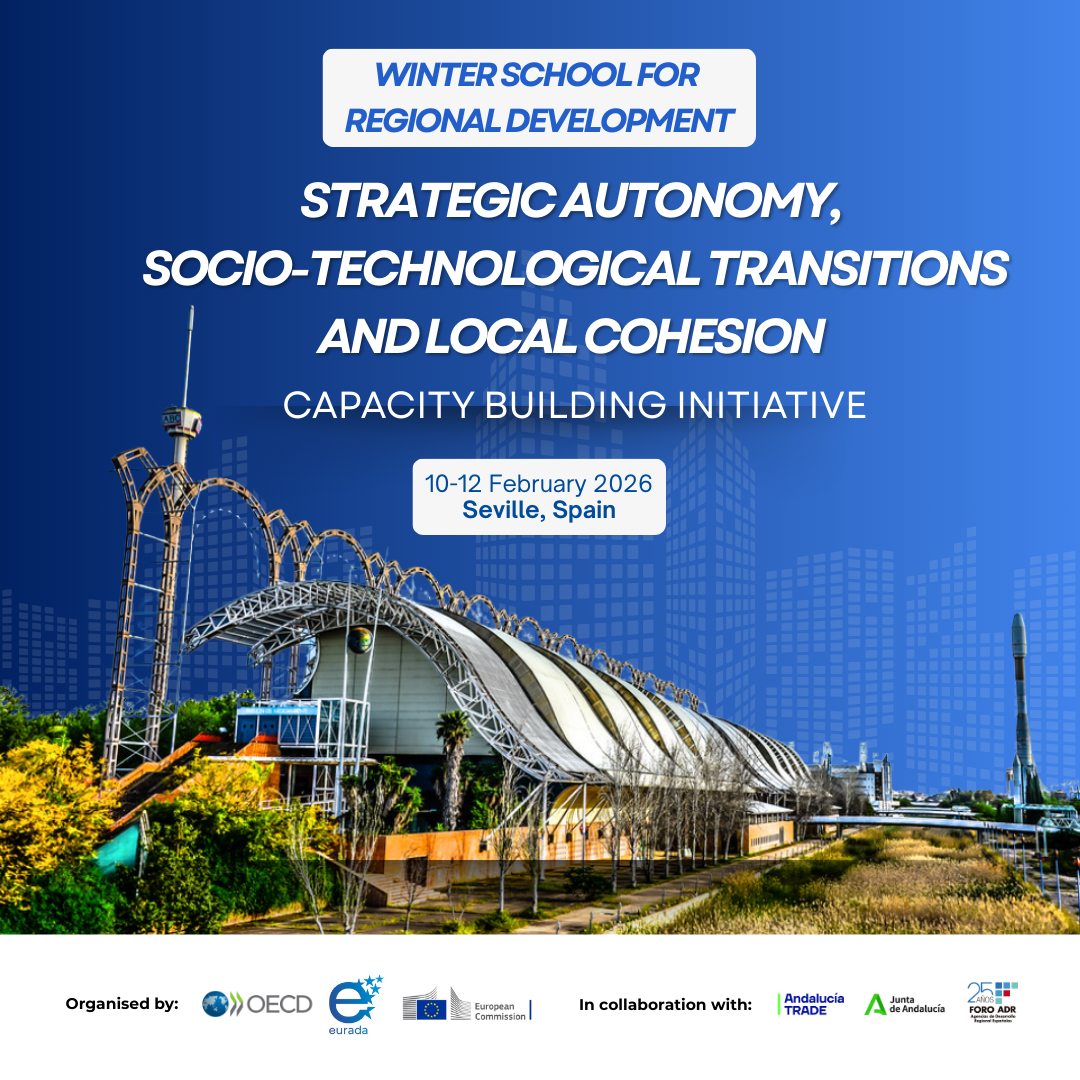
This EURADA capacity-building initiative, titled “Strategic Autonomy, Socio-technological Transitions and Local Cohesion,” is co-organised with the the Joint Research Centre of the European Commission, the Trento Centre for Local Development from OECD, and supported by our Spanish member, TRADE, and national association of Spanish development agencies FORO ADR.
Building on the 2023 and 2024 editions, the 2026 Winter School will explore some of the themes and methods from previous years, as well as potential approaches that regional development actors can adopt in preparation for the shifts that will shape the future of international, national and regional relations.
The three-day capacity building initiative aims to equip regional development actors with the tools to navigate a world marked by rapid change and uncertainty. It highlights the importance of recognising evolving trends and identifying new opportunities that may arise from complex and often challenging conditions. The initiative focuses on integrating an anticipatory mindset into daily operations, while reflecting on the strategic role regional development actors can play in promoting sustainable growth, stability, and resilience.
The Winter School seeks to:
- Examine the key drivers of change shaping regional and local development.
- Stimulate strategic thinking among regional development actors about their role in fostering inclusive regional development and competitiveness.
- Discuss how innovation ecosystems can respond to both civilian needs and strategic priorities.
- Raise awareness of strategic foresight among regional development actors, introducing methodological approaches and tools to help them anticipate potential future challenges and opportunities in regional development.
- Present successful case studies from peer organisations, as well as concrete regional examples.
- Provide a space for mutual learning, networking, and the exchange of good practices among participants, experts, and other stakeholders.
- Stimulate knowledge sharing and foster an environment for collaboration and the development of new approaches to regional development.
Participants profile
The capacity building is targeted to those working in regional development, such as Regional Development Agencies (RDAs), local, regional and national administrations, and PhD and postdoctoral students specialising in regional development.
Fee, logistics and costs
A tuition fee of €400.00 for EURADA members (€500.00 for non-EURADA members) is foreseen for the Winter School.
The organisers will cover transportation costs in Sevilla as well as coffee-breaks, lunches and a dinner during the Winter School, whereas accommodation, travel to Sevilla expenses, medical insurance, entry visa application charges (if required for the specific home country), dinners and other personal expenses not specified in the Winter School agenda, will be borne by selected participants. The modalities of the payment (due on 28 January 2026) will be detailed in the communication of the result of the application.
Application
Participants should be strongly committed to regional development, innovation, development and implementation of EU R&I and/or Cohesion policy. Ideally, they are employed by national or regional development agencies or technological agencies.
- Candidates need to submit duly compiled application via this form online by 8 January 2026, 12:00 CET.
- Candidates are encouraged to propose a topic for a pitch on a theme of the Winter School.
- Notification of selected participants by 13 January 2026. Priority will be given to members of the EURADA Association. If the number of applications exceeds the number of available places, the participants will be selected on the basis of professional attainment and work experience.