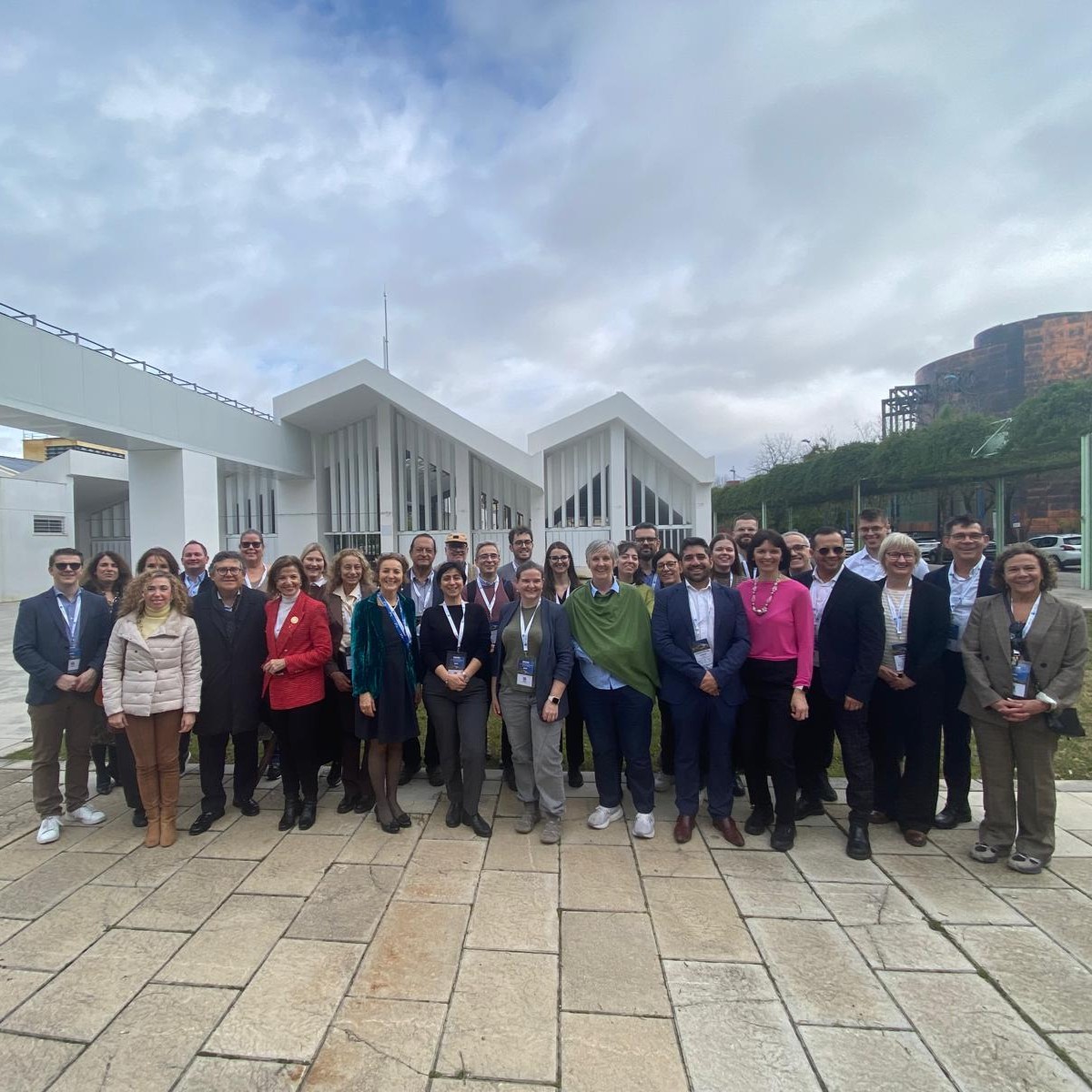
This EURADA capacity-building initiative, titled “Strategic Autonomy, Socio-technological Transitions and Local Cohesion,” was co-organised with the the Joint Research Centre of the European Commission, the Trento Centre for Local Development from OECD, and supported by our Spanish member, TRADE, and national association of Spanish development agencies FORO ADR.
The three-day capacity-building initiative equipped regional development practitioners with tools to navigate a world marked by rapid change and uncertainty. It emphasised the importance of recognising emerging trends and identifying new opportunities arising from complex conditions, while encouraging participants to integrate an anticipatory mindset into their daily work. The programme also reflected on the strategic role regional development actors play in promoting sustainable growth, stability, and resilience.
28 participants from 16 different European countries came to Sevilla for this high-level event. The EURADA network was represented by nine participants from eight Regional Development Agencies: ADR NORD VEST, BRETAGNE NEXT, ICECYL, IVACE, LIOF, Oost NL, SODENA, SPRI and the host organisation, TRADE.
The first day of the programme focused on the future of EU territorial cohesion and the role of the place-based approach in addressing regional disparities, strengthening competitiveness, and enabling systemic change. Participants reflected on how cohesion policy has supported employment, growth, and sustainable development across Europe while helping reduce imbalances between regions. In the context of increasing fragmentation, rising inequalities, and discussions around the forthcoming EU long-term budget for 2028–2034, the sessions explored future directions and challenges for cohesion policy.
Discussions also examined the role of the new Multiannual Financial Framework (MFF) and the contribution of cohesion policy to the twin transition and Europe’s strategic autonomy. Finally, participants reflected on the evolution of smart specialisation strategies in a context of de-globalisation and socio-technical transitions, exploring how regional actors can leverage these policy frameworks to strengthen regional competitiveness. In the afternoon, participants visited the Sevilla Tech Park, with parallel visits organised to the National Center of Accelerators (CNA) and the company Alter Technology.
The second day focused on trends, strategic foresight, and directionality in regional policymaking. Sessions explored futures thinking and transformative foresight in regions, as well as the importance of considering future generations and intergenerational fairness in European territories. Discussions highlighted how strategic foresight can help regional actors move beyond reactive approaches and develop forward-looking policies that align long-term regional objectives with major global transformations such as climate change, digitalisation, demographic change, and economic restructuring.
Participants also examined how to make foresight actionable for place-based policymaking through practical cases and experiences from OECD regions and specific examples such as foresight for STI policymaking in Czechia. Additional sessions explored how gender equality can act as a strategic driver of competitiveness and how shared visioning processes support regional foresight strategies, illustrated by the experience of the Basque Country. In this context, an intervention by SPRI highlighted the contribution of gender equality to innovation processes in SMEs. In the afternoon, participants took part in an interactive foresight workshop, engaging in guided discussions and peer exchanges to reflect on how these themes relate to their own institutional contexts and to identify practical approaches to strengthen preparedness, collaboration, and long-term strategic thinking.
The third day focused on innovation as a key driver of regional resilience and transformation in a context of growing geopolitical uncertainty. Discussions addressed global trade uncertainties and relations with Latin American countries, as well as the implications of dual-use technologies for EU regional policies. Participants also examined the growing importance of jobs and skills in the defence sector and reflected on how regions can strengthen innovation ecosystems capable of addressing both civilian needs and strategic priorities.
Drawing on practical experiences, including evidence from the REGDUALOSA project and examples from OECD regions, the sessions explored how regional innovation systems can contribute to greater strategic autonomy and resilience. Participants were also introduced to initiatives such as the Caetra AETRA Programme, supporting defence-driven regional innovation, and the SIMEK Programme, highlighting the role of Regional Development Agencies in the defence sector. The day also included a pitching session where participants presented projects and exchanged experiences. In the afternoon, participants took part in a study visit to Aerópolis – Aerospace Technology Park.
Participants broadly agreed that regions are facing an increasingly complex environment marked by geopolitical tensions, rapid technological change, and growing socio-economic disparities. In this context, traditional policy approaches are no longer sufficient. Instead, regional actors must adopt more forward-looking, place-based and strategic approaches that combine cohesion policy, innovation, and foresight to better anticipate change, strengthen resilience, and support long-term regional transformation.
Overall, the Winter School proved to be a highly successful initiative that fostered rich exchanges among practitioners, policymakers, and experts from across Europe. By combining policy discussions, practical case studies, workshops, and study visits, the event created valuable opportunities for learning, networking, and collaboration. Building on this positive experience, EURADA looks forward to further developing similar initiatives in the future to continue supporting Regional Development Agencies and regional actors in navigating emerging challenges and opportunities.